
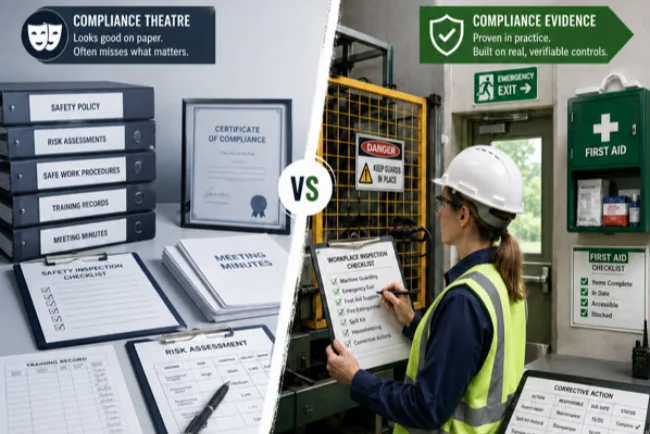
When paperwork looks impressive but the workplace tells a different story.
Many South African workplaces have become very skilled at producing occupational health and safety paperwork. Safety files are neatly indexed. Appointment letters are signed. Inspection registers are available. Policies are printed. Certificates are copied. Committee minutes are filed. On the surface, the organisation appears to be compliant. For management, this often creates comfort. For OHS professionals, however, it should raise a far more important question: does the documentation prove that health and safety is being managed, or does it merely create the appearance that something is being controlled?
This is the difference between compliance evidence and compliance theatre. Compliance evidence is reliable, current, site-specific proof that legal duties are being implemented in practice. Compliance theatre is the performance of compliance: the signed form, the meeting held, the checklist completed, or the certificate filed, without the underlying control actually working. The danger is that both can look very similar until there is an inspection, serious incident, complaint, insurance query, or legal investigation. Only then does the difference become clear.
The Occupational Health and Safety Act 85 of 1993 does not require employers to create an attractive safety file and stop there. Section 8(1) requires every employer to provide and maintain, as far as reasonably practicable, a working environment that is safe and without risk to the health of employees. Section 8(2) expands this duty by requiring, among other things, safe systems of work, steps to eliminate or mitigate hazards, arrangements to ensure safety in connection with articles and substances, the identification of hazards, and the provision of information, instruction, training and supervision. These are active duties. They must be visible in how the workplace is managed every day, not only in what appears in the file.
A signed document is therefore not automatically strong evidence of compliance. A signed appointment letter may prove that someone was appointed, but it does not prove that the person is competent, trained, available, supported, or performing the function. A completed inspection register may prove that a checklist was signed, but it does not prove that defects were corrected. Committee minutes may prove that a meeting took place, but they do not prove that meaningful consultation, recommendations, decisions, and follow-up occurred. In each case, the document is only as strong as the practical activity behind it.
Compliance theatre usually develops gradually. A workplace may start with a reasonable system, but then people resign, duties change, machinery is moved, contractors are introduced, new chemicals arrive, operating hours change, buildings are altered, or production pressure increases. The file remains in place, but the workplace changes around it. Eventually, the documents no longer reflect reality. The file still looks respectable, but it no longer proves effective control.
A practical example is a machinery inspection register that is signed every month with the words “all in order”, while operators know that guards are loose, emergency stops are unreliable, or defects are being bypassed because production must continue. The register may look like evidence, but in reality it may be theatre. True evidence would show that the defect was identified, reported, risk assessed, isolated where necessary, repaired by a competent person, and verified before continued use. If the form is signed but the machine remains unsafe, the document may weaken the employer’s position rather than support it.
The same applies to legal appointments. Section 16(1) of the OHSA places responsibility for health and safety on the chief executive officer or the person deemed to be the chief executive officer. Section 16(2) allows the chief executive officer to assign duties to another person under their control, but this does not remove the chief executive officer’s accountability. Compliance evidence would show that the appointed person has authority, understands the appointment, receives information, has access to resources, and can influence corrective action. Compliance theatre is a signed Section 16(2) appointment in the file while the person has no practical authority, no budget, no access to reports, and no involvement in safety decisions.
Health and safety representatives are another important example. Section 17 requires representatives to be designated in writing in certain workplaces. Section 18 sets out their functions, including reviewing the effectiveness of health and safety measures, identifying potential hazards, examining causes of incidents, investigating complaints, and making representations to the employer. Section 19 requires a health and safety committee where two or more representatives have been designated. Section 20 allows the committee to make recommendations and requires records of recommendations and reports to inspectors. Compliance evidence would include inspections conducted by representatives, hazards raised, recommendations recorded, incidents discussed, corrective actions assigned, and close-out verified. Compliance theatre is a list of names in the file with no proof that representatives are inspecting, reporting, consulting, or influencing the system.
Poor documentation can also work against the employer. Management often assumes that any record is useful because it shows that something was done. That is not always true. A weak record may show that management knew about a hazard and failed to act. Inspection reports that repeat the same defect month after month may prove awareness without control. Committee minutes that repeatedly record unresolved matters may show poor follow-through. Incident records that blame the injured employee without examining system failures may show that the investigation process is superficial. In this sense, poor records may become evidence of poor management rather than evidence of compliance.
Incident investigations provide a clear example. Section 24 of the OHSA deals with certain incidents that must be reported. The General Administrative Regulations also require incident recording and investigation in prescribed circumstances. A proper investigation should not merely state what happened and who was injured. It should examine why the incident occurred, whether existing controls failed, whether the risk assessment was adequate, whether supervision was effective, whether training was sufficient, and whether corrective action reduced the risk. Compliance evidence is an investigation that leads to improved controls. Compliance theatre is an incident form that concludes “employee must be more careful” while the same unsafe condition remains unchanged.
Training records can also become theatrical. Section 13 of the OHSA requires employees to be informed of the hazards attached to their work, the precautionary measures to be taken, and the procedures to be followed. A training attendance register may show that employees were present, but it does not automatically prove understanding, competence, or safe behaviour. Compliance evidence would include training linked to actual workplace hazards, practical demonstration where appropriate, refresher training, supervision, and proof that employees can apply the procedure. Compliance theatre is a signed attendance register for generic training that has little connection to the real tasks being performed.
First aid compliance is another area where paperwork can create false confidence. General Safety Regulation 3 requires first aid equipment to be provided in certain workplaces and requires trained first aiders to be readily available where the employee threshold is met. The words “readily available” are important. A certificate in the file is not enough if the first aider is on leave, off site, unknown to staff, or located too far away to respond effectively. Compliance evidence would show valid certificates, adequate coverage across shifts or buildings, accessible first aid boxes, suitable stock, clear communication, and practical readiness. Compliance theatre is a first aid appointment letter while the box is locked away, stock is missing, or employees do not know whom to call.
Emergency preparedness often shows the same weakness. A workplace may have an emergency plan, a fire team list, evacuation maps, and drill records, but if emergency doors are locked, evacuation routes are obstructed, assembly points are poorly controlled, alarms are not understood, or visitors are not accounted for, the paperwork does not prove readiness. Compliance evidence would include tested procedures, drill observations, corrective actions, updated responsibilities, trained responders, and proof that weaknesses were corrected. Compliance theatre is a fire drill register signed once a year without any meaningful assessment of whether the workplace could evacuate safely under pressure.
Deputy Minister Leads Hard-Hitting Blitz in Vereeniging: Labour Law Breaches. On 4th December 2025, the Department of Employment and Labour reported a blitz inspection in Vereeniging where prohibition notices were served to halt the use of a mixing plant emitting hazardous chemical dust, stop forklift operations by untrained workers, prevent use of unsafe electrical systems, address unstable stacking of sacks, worn-out machinery tyres, and indoor storage of 48 kg LPG cylinders. This example is useful because it shows that enforcement focuses on real workplace conditions and functioning controls, not only on whether documents exist.
A second example involved a mall construction site in Johannesburg. In February 2024, the Department reported that inspectors prohibited construction operations after finding non-compliance, including that no risk assessment was found on site and that the construction company had not even revealed whether a first aid kit was available for injured workers. This is a strong example for OHS professionals because it links directly to the difference between a formal construction operation and the practical absence of basic evidence required to show that risks were being managed.
A third example involved the prohibition of the use of a South African Police Service station in Odendaalsrus in June 2022. The Department reported that the building was still under construction while being used by officials, and that the matter followed reports of occupational hazards, including an incident where an employee was injured by a falling ceiling. The facility was prohibited in terms of section 30 of the OHSA and was to remain closed until the safety issues were corrected to the satisfaction of the labour inspector.
These examples are valuable because they move the discussion away from abstract paperwork and back to physical risk. A file may contain an appointment letter, but an untrained forklift operator is still a risk. A risk assessment template may exist, but if no risk assessment is available or applied on site, the control is absent. A maintenance register may exist, but a collapsing ceiling or unsafe electrical system shows that the workplace condition itself is not being controlled. Inspectors compare documents with reality. If reality contradicts the file, the file loses credibility.
Contractor management is another area where compliance theatre is common. Many workplaces collect contractor documents but do not manage contractor activities. A contractor file may contain a letter of good standing, training certificates, medicals, risk assessments, and induction records. These documents are important, but they are not the full control. Compliance evidence would show that the contractor’s work was reviewed, site-specific hazards were communicated, high-risk tasks were supervised, unsafe conduct was corrected, and access was controlled. Compliance theatre is a contractor file accepted at reception while the contractor works unsupervised, blocks emergency routes, uses defective equipment, or performs work outside the agreed scope.
Risk assessments are often the centre of compliance theatre. Section 8 requires the employer to identify hazards and take precautionary measures. A risk assessment that is copied from another site, not reviewed after changes, or not linked to procedures is weak evidence. A proper risk assessment should influence safe work procedures, training, supervision, signage, emergency planning, PPE, maintenance, and inspections. If the risk assessment exists but nothing in the workplace changes because of it, it is not functioning as a control. It is a document pretending to be a system.
The professional test is simple: can the organisation prove implementation? If a document says that monthly inspections are conducted, can the employer show findings, corrective action, responsible persons, target dates, and close-out verification? If the file says employees were trained, can the employer show that the training addressed the actual hazards and that employees understood the procedure? If the file says emergency equipment is checked, can the employer show that defects were corrected? If the committee minutes record hazards, can management show what was done about them? If the answer is no, the evidence is weak.
Compliance theatre also creates a cultural problem. It teaches employees that safety is about signatures, not control. People learn that the important thing is to complete the register, not to identify the defect. They learn that the meeting must be held, not that the hazard must be resolved. They learn that the file must look good, not that the workplace must improve. Over time, this damages the credibility of the OHS system. Employees stop reporting hazards because nothing changes. Representatives stop raising issues because recommendations are not acted on. Supervisors sign forms because forms are expected. Management receives paperwork and assumes the system is working.
For OHS professionals, the task is to move organisations from performance to proof. This requires difficult but necessary questions. Does this document reflect the current workplace? Who uses this register? What happens when a defect is recorded? Who reviews the inspection results? How do we know the control works? When was this risk assessment last tested against actual operations? Are committee recommendations tracked until closed? Are employees able to explain the procedures they signed for? These questions separate evidence from theatre.
Strong evidence is current, specific, traceable, and verifiable. It connects the legal duty to the workplace activity. It shows what was identified, what was decided, who was responsible, when action was due, what was done, and whether the action worked. Weak evidence is vague, generic, outdated, incomplete, copied, or disconnected from site conditions. It records activity but not control. It shows attendance but not understanding. It shows inspection but not correction. It shows discussion but not decision.
The solution is not to remove documentation. Documentation remains essential. The problem is not that workplaces have safety files; the problem is that many workplaces treat the file as the end point rather than the evidence trail. A safety file should be the record of a living system. It should show that hazards are identified, risks are assessed, controls are implemented, people are trained, equipment is maintained, incidents are investigated, committees function, and corrective actions are closed. The file should not create an illusion of safety. It should prove that safety is being managed in practice.
Management should also understand that compliance evidence does not need to show perfection. It must show active, reasonable, traceable management. A register showing a defect may still be useful if it also shows escalation, interim controls, repair, and verification. A committee minute showing an unresolved risk may still support the employer if it records a clear recommendation, responsible person, management decision, and timeframe. A risk assessment identifying a high risk may be defensible if it also shows reasonable steps taken to reduce that risk. Honest evidence of active control is far stronger than polished paperwork that hides weakness.
Compliance theatre, by contrast, often shows the opposite. It shows that the organisation knew enough to create the paperwork but failed to implement the control. It shows that management had systems on paper but did not test whether they worked. It shows that hazards were visible, meetings were held, reports were written, and signatures were collected, but the risk remained. That is why theatre is so dangerous. It gives confidence before the incident and creates exposure after the incident.
The professional message is clear. A document is not a control unless it changes behaviour, guides decisions, supports supervision, triggers corrective action, or proves that a legal duty is being implemented. A meeting is not a control unless it results in recommendations, decisions, and follow-up. A checklist is not a control unless defects lead to correction. A training register is not a control unless employees understand and apply what they were taught. A safety file is not a control unless it reflects the reality of the workplace.
The difference between compliance evidence and compliance theatre is therefore not academic. It is the difference between a defensible OHS system and a paper performance. It is the difference between a workplace that can prove reasonably practicable action and one that can only prove that forms were completed. OHS professionals should be encouraging employers to ask a more mature question: not “Do we have the document?” but “Can this document prove that the control works?”
A workplace does not become compliant because the file is thick, the meeting was held, or the form was signed. It becomes compliant when the legal duty is translated into practical action and that action is visible, current, and verifiable. Anything less may look like compliance, but it is only theatre.
Compliance evidence proves that safety is being managed. Compliance theatre only proves that paperwork exists.
[ Please download ]