
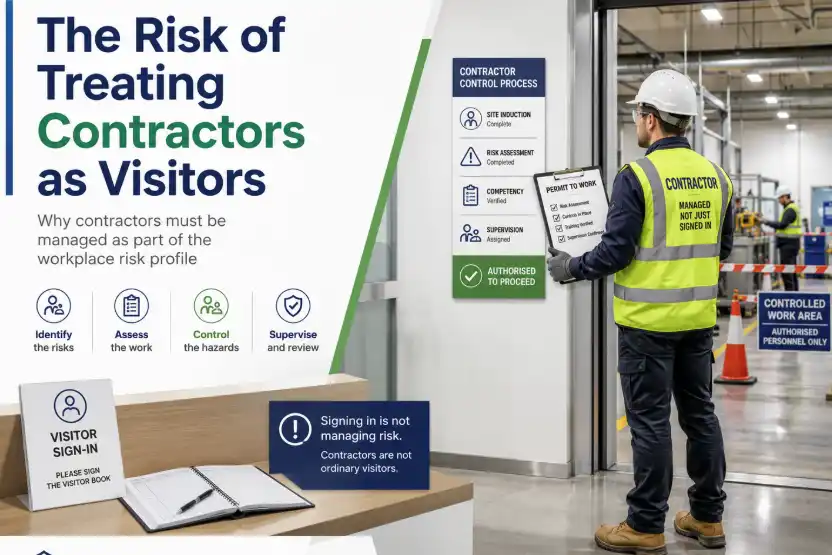
Why contractors must be managed as part of the workplace risk profile, not simply signed in and left to work.
Many workplaces manage contractors as if they are ordinary visitors. They arrive at reception or security, sign a register, receive an access card or visitor sticker, and are allowed onto site. From an administrative point of view, this may look controlled. From an occupational health and safety point of view, it can be a serious weakness.
A visitor normally enters a workplace for a limited purpose and is often accompanied or restricted to certain areas. A contractor is different. A contractor performs work. That work may introduce new hazards, increase existing risks, expose employees or members of the public to danger, or place the contractor’s own employees at risk from site conditions. Contractors may work with electricity, ladders, tools, chemicals, vehicles, machinery, hot work, roofs, plant rooms, kitchens, laboratories, construction areas, maintenance rooms, or security systems. Treating such persons as visitors ignores the most important point: they are not merely present on site; they are changing the risk profile of the workplace.
This is where many organisations fall into compliance theatre. The contractor file may contain a letter of good standing, public liability insurance, identity documents, training certificates and a signed induction form. These documents are useful, but they are not enough on their own. The real question is whether the contractor’s work is controlled in practice. Has the task been risk assessed? Has the contractor been informed of site-specific hazards? Are employees, learners, patients, visitors or other contractors protected from the contractor’s activities? Is the work supervised or monitored? Are emergency arrangements clear? Are unsafe activities stopped?
The Occupational Health and Safety Act 85 of 1993 provides the legal starting point. Section 8(1) requires every employer to provide and maintain, as far as reasonably practicable, a working environment that is safe and without risk to the health of employees. Section 8(2) expands this duty and includes safe systems of work, the elimination or mitigation of hazards, arrangements for safety in connection with articles and substances, hazard identification, precautionary measures, information, instruction, training and supervision. These are active duties. They do not disappear because an outside contractor is performing the work.
Section 9 is equally important. It requires every employer to conduct their undertaking in such a manner as to ensure, as far as reasonably practicable, that persons other than employees who may be directly affected by the employer’s activities are not exposed to hazards to their health or safety. In practice, this means the employer must consider how its workplace activities may affect contractors, and how contractor activities may affect employees, visitors, learners, patients, customers or the public.
Section 13 also remains relevant in principle. Employees must be informed of the hazards attached to their work, the precautionary measures to be taken, and the procedures to be followed. A similar practical approach should be applied to contractor control. A contractor cannot work safely if they do not understand the site-specific hazards, emergency procedures, restricted areas, access rules, reporting requirements and controls that apply to the work being performed.
A further key provision is section 37 of the OHSA, which deals with acts or omissions by employees or mandataries. In practice, this is why employers often enter into a written section 37(2) agreement with contractors. However, this agreement should not be treated as a document that transfers all responsibility away from the client or host employer. It is part of the evidence trail, but it must be supported by actual contractor management. A signed agreement without induction, risk assessment, monitoring, supervision and enforcement may become another example of paperwork that looks impressive while the workplace tells a different story.
Construction work requires even stronger control. Under the Construction Regulations, 2014, contractor management is not optional. Where construction work is involved, the client has specific duties, including preparing a baseline risk assessment and a suitable, sufficiently documented, site-specific health and safety specification. The client must also take reasonable steps to ensure that the principal contractor has made adequate provision for health and safety and has the necessary competencies and resources to carry out the work safely. The principal contractor must develop a suitable, sufficiently documented and site-specific health and safety plan based on the client’s health and safety specification. This demonstrates an important legal principle: higher-risk contractor work must be planned, assessed, documented, supervised and controlled before and during the work.
The difference between a visitor and a contractor is therefore crucial. A visitor induction may be short and general: where to sign in, where to park, whom to report to, what to do if the alarm sounds, and which areas are restricted. A contractor induction must go further. It should deal with the actual work to be performed, the hazards created by that work, the hazards already present on site, emergency arrangements, permits where applicable, PPE requirements, reporting procedures, supervision, access limitations and stop-work expectations.
Practical examples are easy to identify. An electrician working on a distribution board may expose people to electrical hazards if the area is not isolated, locked out, demarcated and controlled. A cleaning contractor using chemicals may create slip hazards, exposure risks or incompatible chemical storage risks if the work is not planned. A maintenance contractor using a ladder in a passage may expose employees, visitors or children to falling object or collision risks. A contractor working on a roof may create fall risks, falling-material risks and rescue challenges. A delivery contractor reversing into a busy yard may create vehicle-pedestrian risks. None of these are ordinary visitor risks. They are work activity risks.
A common weakness is that procurement and OHS do not speak to each other. A contractor may be approved because they are affordable, available, familiar or administratively compliant. However, OHS suitability must be considered before work starts. Does the contractor have the competence to do the work safely? Are they in good standing where applicable? Are employees trained and competent? Are task-specific risk assessments and safe work procedures available? Will the work require permits, isolation, barricading, after-hours arrangements, supervision or emergency planning? Have site-specific hazards been communicated?
Another weakness is failing to define responsibility. The host employer may assume the contractor is responsible for everything. The contractor may assume the client has made the site safe. Employees may assume management knows what the contractor is doing. Security may assume that signing in is enough. This uncertainty creates risk. Contractor management must clearly allocate responsibilities for access, induction, supervision, permits, emergency procedures, housekeeping, waste removal, chemical storage, equipment safety, electrical isolation, working at heights, incident reporting and close-out evidence.
The contractor file should therefore be more than a collection of documents. It should be a working control file. It should include evidence that the contractor was approved with OHS in mind; that the scope of work is clear; that site-specific hazards were considered; that training and competence are appropriate; that risk assessments and safe work procedures match the actual task; that induction was completed before work started; that permits were issued where required; that the work was monitored; that incidents and near misses were reported; and that close-out was verified.
Emergency arrangements are often overlooked. Contractors must know what to do if the alarm sounds, where to assemble, who to report to, how to summon first aid, how to report an incident, and which areas are restricted during an emergency. The host employer must also know how many contractors are on site. If contractors sign in but cannot be accounted for during an evacuation, the access register is a weak control.
First aid arrangements must also be clear. General Safety Regulation 3 requires first aid equipment and trained first aiders where the employee thresholds are met. In contractor management, the practical question is how injured contractors will receive prompt assistance and how incidents will be reported and investigated. Contractors must know whether they are expected to provide their own first aider, how to access the host employer’s first aid arrangements, and who must be notified if an incident occurs.
Incident reporting and investigation must be agreed before the work starts. If a contractor is injured, or if contractor work injures an employee, damages property, creates a near miss or exposes people to hazardous substances, the incident must not disappear into the contractor’s own system only. The host employer must be informed. The site risk assessment may need to be reviewed. Controls may need to be changed. The health and safety committee may need to discuss the incident where applicable. The purpose is not only to record what happened, but to prevent recurrence.
Contractor management is also a safety culture issue. Employees notice when contractors are allowed to work outside the standards expected from internal staff. They see contractors working without PPE, leaving tools unattended, blocking emergency routes, using ladders unsafely, reversing vehicles without control, or using chemicals without warning others. This damages the credibility of the OHS system. A workplace cannot claim to have strong safety standards if contractors are allowed to operate outside those standards.
The solution is not to make contractor management unnecessarily complicated. The solution is to make it risk-based. A low-risk contractor delivering stationery does not need the same level of control as a contractor working on electrical systems, roofs, machinery, fire systems, kitchens, laboratories, chemical storage areas or construction work. However, every contractor must be considered within the workplace risk profile. The higher the risk, the stronger the planning, evidence, supervision and close-out must be.
A practical contractor management process should include pre-approval, scope confirmation, document review, site-specific induction, risk assessment review, permit control where needed, supervision or monitoring, incident reporting, emergency communication and close-out. For higher-risk work, the employer should also require method statements, proof of competence, equipment inspection records, medical fitness where applicable, fall protection planning where applicable, lockout arrangements, hot work controls, isolation procedures and evidence of corrective action.
The key professional question is not, “Did the contractor sign in?” The correct question is, “Have we controlled the risk created by this contractor’s work?” Signing in only proves presence. It does not prove competence, safe work, supervision, emergency readiness or legal control. A contractor register may tell management who entered the site, but it does not prove that the work was safe.
Contractors must therefore be managed as part of the OHS system, not as an administrative interruption at reception. Their work must link to the site risk assessment, emergency plan, induction process, supervision system, incident reporting process, health and safety committee feedback and management accountability.
A workplace does not discharge its duty by allowing a contractor through the gate. It discharges its duty by taking reasonably practicable steps to ensure that the contractor’s work is planned, communicated, controlled and monitored. The contractor must not merely be present on site. The contractor must be integrated into the safety system.
Contractors are not visitors when they perform work. They bring tools, tasks, hazards, decisions and consequences into the workplace. If they are simply signed in and left to continue, the employer may be left with the appearance of access control but not the reality of risk control.
A contractor register proves who entered the site. Contractor management proves that the work was controlled.
[ Download ]