
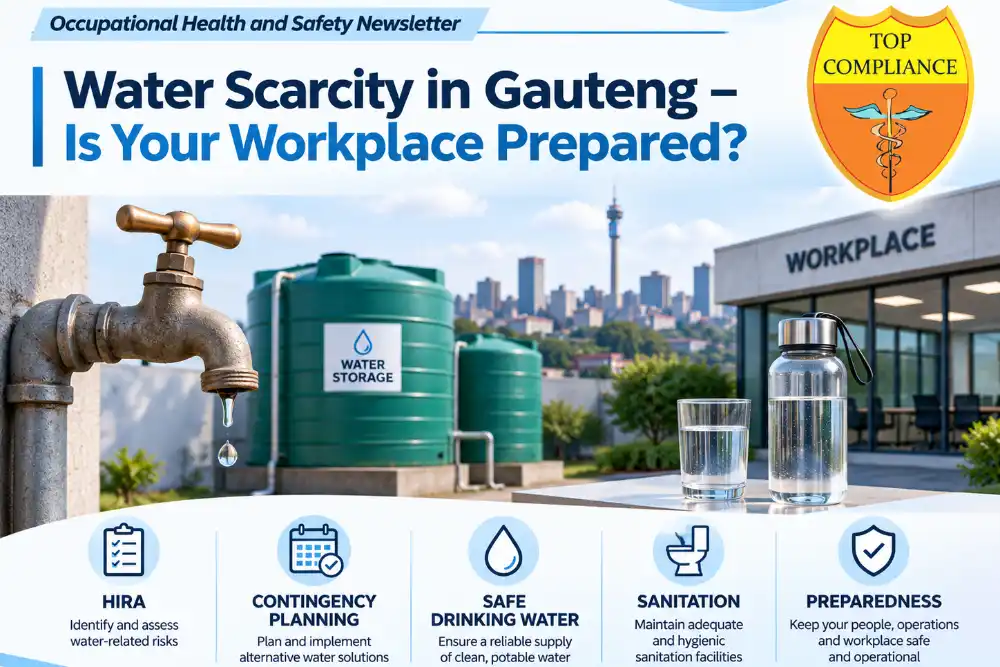
Unpredictable municipal supply, low water pressure and prolonged interruptions across parts of Gauteng create more than an inconvenience. Workplaces depend on water for drinking, sanitation, handwashing, food preparation, cleaning, fire protection and essential operations. When these needs cannot be met, employees, learners, visitors and vulnerable people may be exposed to preventable health and safety risks.
Section 8(1) of the Occupational Health and Safety Act 85 of 1993 requires employers, as far as reasonably practicable, to maintain a working environment that is safe and without risk to employees’ health. Section 8(2)(d) addresses the identification of work-related hazards and the precautionary measures needed to control them. Section 9(1) extends protection, as far as reasonably practicable, to persons other than employees who may be affected by an undertaking. Regulation 7 of the Facilities Regulations, 2004 requires an adequate supply of drinking water for employees and clear identification of taps and pipes containing water unfit for human consumption.
Municipal supply failures do not automatically remove these duties. Where food is handled, the hygiene requirements of Regulation R638 of 2018 must also be considered. Management must establish whether the organisation can continue its activities safely with the water actually available, rather than the water it expects to receive.
A water-shortage hazard identification and risk assessment (HIRA) should address reduced pressure, intermittent delivery, complete outages and uncertainty about the safety of supplied or stored water. Hazards include dehydration, heat-related illness, inadequate toilet flushing, inability to wash hands, food contamination, unsafe water-dependent equipment or firefighting systems, and contamination during storage or distribution. Moving heavy containers can also introduce manual-handling, slipping and tripping hazards.
The HIRA must identify who may be affected, how quickly existing controls could fail, what alternative supplies are available and when activities should be restricted. For example, a school with bottled drinking water but no adequate handwashing or toilet facilities may still be unable to operate hygienically. The assessment must extend beyond drinking water to sanitation, food safety, vulnerable persons and the essential functions of the site.
A documented water contingency plan should specify minimum quantities needed for safe occupancy, drinking, hand hygiene, sanitation, food preparation, animal care and water-dependent operations. It should identify reliable alternative suppliers, available storage capacity, arrangements for deliveries, responsible persons, cleaning procedures, water-quality checks and trigger points for reducing or suspending activities. Stored water levels and the condition of tanks, pipes and dispensing points should be inspected and recorded. Plans must be communicated, tested where practicable and reviewed after each significant disruption.
Water from tankers, boreholes, rainwater systems or static tanks must not automatically be regarded as potable. Its suitability should be established using reliable supplier evidence and risk-appropriate testing against SANS 241:2025, the South African drinking-water quality standard. Use food-grade, covered and properly maintained drinking-water containers; keep potable and non-potable supplies separate; prevent cross-connections and backflow; and clearly mark outlets that are not safe for human consumption. A change in taste, odour, appearance or supply conditions warrants investigation, but water that looks normal may still be contaminated.
The response to a suspected water-quality problem depends on the official advisory. For a microbiological boil-water advisory, clear water may be brought to a full rolling boil for one minute, or three minutes above approximately 2,000 metres altitude, and then cooled and stored safely. Boiling does not remove toxic chemicals or heavy metals. A “do not drink” or “do not use” advisory must be followed exactly; in such circumstances boiling may be insufficient or inappropriate. Use an approved alternative source until the relevant authority confirms that normal use may resume.
Contaminated water can transmit disease-causing viruses, bacteria and parasites, including norovirus, Shigella, Campylobacter, certain pathogenic E. coli strains, Giardia and Cryptosporidium. Cholera and typhoid fever are other important water-related infections, but their presence must not be assumed without appropriate investigation. Symptoms may include diarrhoea, vomiting, abdominal cramps, fever and dehydration. Chemical contaminants can cause different toxic effects and cannot be managed as ordinary infectious gastroenteritis.
This risk is not theoretical. In a joint government statement on 19 October 2026, health and water authorities reported a cluster of gastrointestinal illness linked to contaminated water supplied from the Bronkhorstspruit Water Treatment Works in parts of Tshwane. Laboratory findings identified multiple gastrointestinal pathogens. The statement concerned specified affected areas and must not be interpreted as evidence that all Gauteng drinking water was contaminated.
Prevention depends on verified safe drinking water, protected storage, effective sanitation and thorough handwashing with soap and safe water, particularly after using the toilet and before handling food. Where necessary, provide a temporary handwashing station; alcohol-based hand sanitiser is not a complete substitute when hands are visibly soiled or where certain gastrointestinal pathogens are involved. Food preparation, ice-making, cleaning of utensils and oral rehydration solutions must use water suitable for their intended purpose. Suspected contaminated supplies must be isolated and reported promptly.
For a person with diarrhoea or vomiting who is alert and can swallow safely, oral rehydration solution (ORS), correctly prepared with safe water and used according to the product instructions, helps replace lost fluids and salts. Small, frequent sips are often better tolerated; usual feeding may continue as tolerated. Seek urgent medical assessment for blood in the stool, severe or persistent symptoms, inability to retain fluids, marked reduction in urination, dizziness, unusual drowsiness, confusion or other signs of significant dehydration. Severe dehydration may require intravenous fluids and hospital treatment.
Older people may have a reduced sensation of thirst, decreased physiological ability to regulate body temperature, mobility limitations or difficulty obtaining and carrying water. Chronic conditions, including heart and kidney disease and diabetes, and medicines such as diuretics may increase vulnerability to dehydration and heat-related illness. Care facilities, employers and families should assess access to safe drinking water, usable toilets, handwashing, shaded or cool areas and additional assistance during interruptions. Regular welfare checks are important, especially for those who live alone or rely on others for water deliveries.
Do not apply a single fixed fluid-intake target to everyone: individuals with prescribed fluid restrictions or complex medical conditions require personalised advice from their treating clinician. New confusion, fainting, marked weakness, very little urine or inability to drink should prompt urgent medical assessment.
Heat exhaustion usually develops when heat exposure and sweating cause excessive loss of fluids and salts. The person may experience heavy sweating, thirst, headache, nausea, weakness, dizziness, a rapid pulse or reduced urine output, but ordinarily remains mentally alert. Stop the activity, move the person to a cooler place, loosen excess clothing and actively cool the skin using wet cloths, water and airflow. If fully alert and able to swallow, provide frequent sips of cool safe water or an appropriate rehydration drink. Stay with the person and arrange medical evaluation, especially if symptoms are significant, worsening, accompanied by vomiting or not improving promptly.
Heatstroke is a life-threatening medical emergency in which the body cannot adequately control its temperature. Warning signs include confusion, altered behaviour, slurred speech, collapse, seizures or unconsciousness; a person may still be sweating, so dry skin is not required for diagnosis. Immediately call emergency medical services (112 from a cellphone or 10177 for public ambulance services), move the person out of the heat and begin rapid active cooling while help is arranged. Cold-water immersion may be effective where safe and trained assistance is available; otherwise use repeated wetting, strong airflow and cold packs or wet towels around the neck, armpits and groin. Never delay cooling to obtain a temperature reading. Do not give oral fluids to anyone with altered consciousness or an unsafe swallow; assess breathing and begin CPR if indicated by first aid training.
Prevention requires adequate safe drinking water, scheduled rest breaks, accessible cool or shaded areas, appropriate ventilation, gradual acclimatisation for heat-exposed workers, and adjustment of strenuous tasks during hot periods. Supervisors must recognise early illness and know when to remove a person from exposure. Water shortages can undermine these controls and should therefore be explicitly included in the HIRA.
Animals kept at schools, workplaces, shelters and farms also require sufficient clean, safe water, clean containers and protection from heat. Section 2(1)(c) of the Animals Protection Act 71 of 1962 addresses the unnecessary denial of water or food to an animal. The contingency plan should account for the species, number and needs of animals, increased demand during hot weather, safe storage and a dependable alternative supply. Do not assume water declared unsafe for people is safe for animals, particularly where chemical contamination is suspected; obtain veterinary guidance when necessary.
Management should allocate responsibility for the water-shortage HIRA, alternative supplier verification, storage maintenance, health surveillance, sanitation checks and the decision to restrict activities. The OHS committee should review recurring problems and the effectiveness of corrective action. Evidence may include risk assessments, supplier and water-quality records, tank inspection logs, emergency communications, incident reports and decisions about temporary closures or changes to operations.
Water availability, safe drinking water, disease prevention and heat protection are interconnected. An effective HIRA establishes the hazards and limits of safe operations; a tested contingency plan provides realistic alternatives and a clear decision to stop work when essential controls cannot be maintained.
[ Download ]