
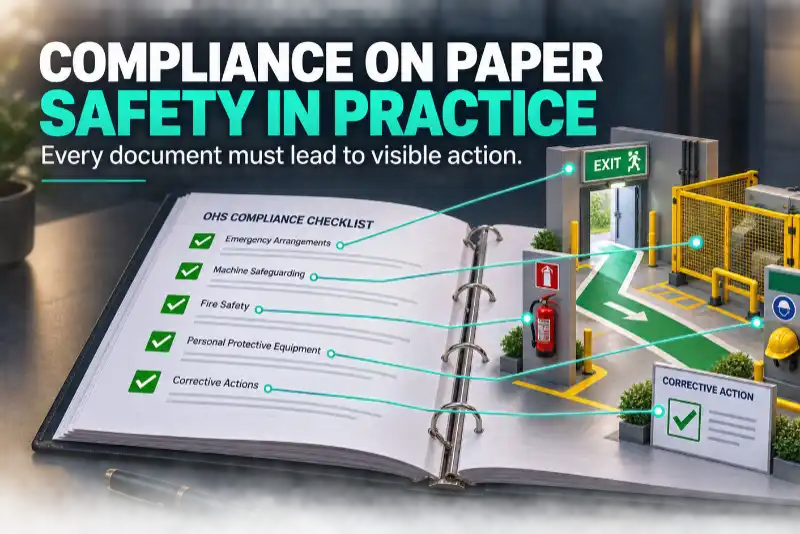
A workplace can have an impressive health and safety file and still have serious hazards on the floor. Documents are important, but they should provide evidence that the safety system is working. They should not become a substitute for action.
Appointments, risk assessments, procedures, inspection records, training records and committee documents provide structure, accountability and evidence. They help an organisation record what was assessed, communicated, inspected, investigated and corrected.
The problem begins when completing the document becomes the objective. A checklist marked ‘OK’ does not make damaged equipment safe. A signed appointment does not mean that the appointed person understands or performs the function. A training certificate does not prove that the safe method is being followed. A documented hazard is not controlled until suitable precautions are implemented.
The document should support the control. The document is not the control.
Section 8(1) of the Occupational Health and Safety Act 85 of 1993 requires an employer, as far as is reasonably practicable, to provide and maintain a working environment that is safe and without risk to employees’ health.
Section 8(2) makes this a practical duty. It includes safe systems of work, identifying hazards, determining and applying precautionary measures, providing the necessary information, instruction, training and supervision, ensuring compliance and enforcing required health and safety measures.
Section 13 requires employees, as far as is reasonably practicable, to be made conversant with the hazards connected to their work and the precautions to be taken. Section 14 requires employees to take reasonable care, cooperate with the employer, obey lawful health and safety rules and report unsafe or unhealthy situations.
Legal compliance is not proved by the existence of a file alone. The workplace must show that applicable duties and precautions are being implemented and maintained in practice.
A paper-practice gap exists when the formal safety system says one thing, but the actual workplace shows something different.
1 Every checklist says OK
Identical results month after month should invite closer examination, especially where conditions change or visible defects exist. Section 18 allows a health and safety representative to review the effectiveness of measures, identify potential hazards and inspect the workplace, plant, machinery, substances and safety equipment.
Simple example: A representative marks every fire extinguisher as satisfactory. During a walkabout, one extinguisher is obstructed and another has damaged signage. The organisation should determine whether the inspection process is effective, not merely whether the form was submitted.
2 Risk assessments no longer reflect the work
Equipment, substances, layouts, staffing and work methods change. Section 8(2)(d) requires the employer, as far as is reasonably practicable, to establish the hazards attached to the work and determine the precautions required, including providing the means to apply them.
Simple example: The assessment states that loads are moved mechanically, but employees regularly carry them manually because the equipment is unavailable. The documented assessment and the real task no longer match.
3 Training is measured by certificates instead of understanding
A certificate confirms that training took place. It does not, by itself, demonstrate that the employee understands and applies the precautions. Section 8(2)(e) refers to the information, instruction, training and supervision necessary to protect employees, as far as is reasonably practicable.
Simple example: An employee has completed training for a hazardous task but omits a critical isolation step when asked to demonstrate the procedure. Further instruction, coaching or supervision may be necessary.
4 People are appointed but do not perform the function
A signed appointment is only the beginning. Where health and safety representatives are required and designated under section 17, their functions may include inspections, reviewing measures, identifying hazards, investigating complaints and making representations. Section 18(3) requires the employer to provide the facilities, assistance and training reasonably required and agreed upon for those functions.
Simple example: A representative has a signed appointment but has never inspected the designated area and does not know how to report or escalate a hazard.
5 Committee meetings happen but nothing changes
Where section 19 applies, the committee must meet as often as necessary, but at least once every three months. The employer must consult with the committee on developing, maintaining and reviewing health and safety measures. Under section 20, the committee may make recommendations and must keep records of recommendations made to the employer and reports made to an inspector.
Simple example: ‘Repair damaged flooring’ appears at several meetings without a responsible person, suitable interim precautions, a completion date or verification. Repeating the item has not controlled the hazard.
6 Incidents are investigated but causes are not corrected
General Administrative Regulation 9 requires recordable incidents to be investigated, with findings entered in the prescribed record. The relevant records must be examined by the health and safety committee at its next meeting, where a committee exists, and the employer must ensure that necessary actions, as far as reasonably practicable, are implemented and followed up to prevent recurrence.
Simple example: Three employees slip in the same wet area. Each form says, ‘Employee reminded to be careful’, but the source of the water, drainage, flooring and housekeeping arrangements are not examined.
7 Procedures exist but employees use shortcuts
A procedure can be technically correct but difficult to follow because equipment is unavailable, the layout has changed, time is unrealistic or supervisors tolerate deviations. Section 8 requires suitable precautions, the means to apply them, supervision and enforcement.
Simple example: The procedure requires a suitable step ladder, but employees stand on chairs because the ladder is kept in another building. The unsafe action must be corrected, and the reason that the safe method is not readily available must also be addressed.
This changes the focus from ‘Show me the document’ to ‘Show me that it works.’
In an effective system, the evidence connects. The hazard assessment identifies the hazard. The procedure explains the safe method. Training communicates it. Supervision reinforces it. Inspections test whether it is followed. Reports and investigations identify weaknesses. Corrective actions address them. Management and the committee follow up where applicable. The workplace confirms that the controls are in place.
When these elements support one another, documentation becomes evidence of an operating safety system rather than a collection of forms prepared for an audit.
Ask: What should I be able to see happening in the workplace if this document is accurate and effective? If the answer cannot be demonstrated, investigate further.
Good documentation matters. It provides structure, continuity, accountability and evidence. Occupational health and safety, however, is achieved when hazards are identified, suitable controls are implemented, people understand what is expected, unsafe conditions are corrected and management verifies that the system works where the work is performed.
Do not only ask, ‘Are we compliant?’ Ask, ‘Can we demonstrate that our controls are working?’ That is where paper compliance becomes safety in practice.
Top Compliance assists organisations with occupational health and safety audits, HIRAs, procedures, corrective-action guidance, committee support, emergency planning and practical training for health and safety representatives, managers and employees.
Yours in Health and Safety | Top Compliance (Pty) Ltd
Occupational Health and Safety Act 85 of 1993, as amended, particularly sections 8, 13, 14 and 17 to 20.
General Administrative Regulations, 2003, particularly regulations 5 and 9.