
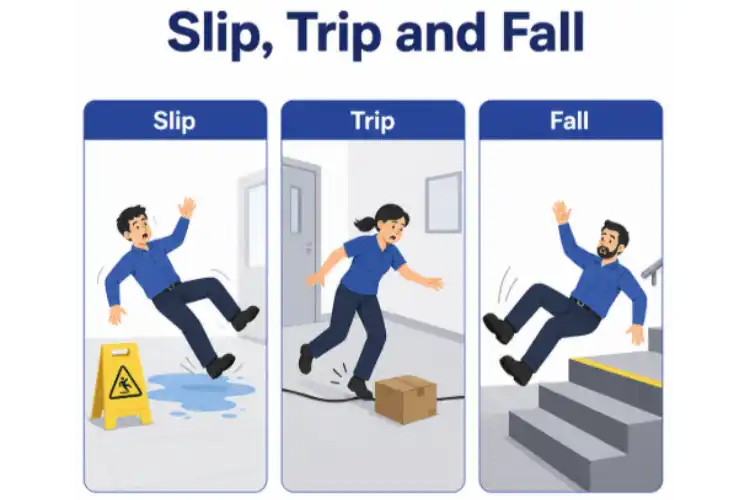
Have you ever almost slipped, tripped or fallen?
Most people have had a moment where they nearly slipped on a wet floor, tripped over a cable, missed a step, or lost their balance while carrying something. Often, people laugh it off and carry on. However, in the workplace, a near miss of this nature must be taken seriously because the next person may not be so lucky.
Slips, trips and falls are some of the most common workplace incidents. They can happen in offices, workshops, factories, kitchens, schools, warehouses, parking areas, staircases, walkways and outdoor areas. A fall does not have to be from a height to cause serious injury. A simple fall on the same level can result in sprains, fractures, head injuries, back injuries, lost time, medical treatment, compensation claims and disruption to work.
Updated slip, trip and fall statistics
Recent statistics confirm that slips, trips and falls remain one of the most common workplace injury causes. According to the United Kingdom Health and Safety Executive, slips, trips or falls on the same level accounted for 30% of non-fatal workplace injuries reported under RIDDOR in 2024/25. Falls from height accounted for a further 8% of reported non-fatal workplace injuries. The HSE also reported an estimated 2,070 self-reported non-fatal injuries per 100,000 workers in 2024/25.
Fatality statistics also show why fall-related hazards must be taken seriously. The HSE reported that 124 workers were killed in work-related accidents in Great Britain in 2024/25. Of these, 35 fatalities were caused by falls from height, making falls from height the leading kind of fatal accident for workers in that reporting year. The same HSE report also recorded 92 members of the public killed in work-related accidents in 2024/25.
In the South African context, recent publicly available figures are less specific for slips, trips and falls as a separate category. However, the Compensation Fund Annual Report for 2023/24 reported that the Fund received 107,713 claims during the financial year. This confirms that occupational injuries and diseases continue to create a significant compensation and workplace-management burden in South Africa.
The South African Department of Employment and Labour also reported in November 2024 that approximately eight workers die in the South African construction sector every month due to work-related incidents, and that more than 60,000 construction workers die globally each year. Although this is construction-sector data and not limited to slips, trips and falls, it highlights the seriousness of fall-risk work, poor training and non-compliance.
Globally, the International Labour Organization has estimated that approximately 2.93 million people die each year from work-related factors, and approximately 395 million workers sustain non-fatal work injuries each year. These figures reinforce the importance of preventing everyday workplace hazards, including slips, trips and falls, before they result in injury or death.
Where South African slip, trip and fall statistics are not available as a clearly separated category, it is recommended to use the HSE figures as an international benchmark and state this clearly. The figures should not be presented as South African slip, trip and fall statistics unless the source specifically confirms this.
What is the difference between a slip, trip and fall?
A slip usually happens when there is too little grip between the shoe and the walking surface. This may be caused by water, oil, grease, dust, wet tiles, smooth floors, poor footwear or weather conditions.
A trip usually happens when a person’s foot strikes an object or uneven surface, causing them to lose balance. This may be caused by loose cables, uneven paving, damaged carpets, poor housekeeping, open drawers, stored items in walkways, pallets, mats or changes in floor level.
A fall happens when a person loses balance and comes down to the ground or to a lower level. Falls may happen on the same level, from stairs, from ladders, from platforms, from vehicles, or from elevated work areas.
Possible outcomes of slip, trip and fall incidents
Slip, trip and fall incidents can have a wide range of outcomes. A near miss may appear minor, but it is often an early warning sign that an uncontrolled hazard exists in the workplace. If the hazard is not reported, investigated and corrected, the next incident may result in injury or even death.
Possible outcomes include:
Why must slips, trips and falls be included in the Hazard Identification and Risk Assessment (HIRA)?
The Hazard Identification and Risk Assessment is one of the most important tools used to identify what can go wrong before someone is injured. Slips, trips and falls must not be treated as “minor” hazards. They must be identified, assessed and controlled in each work area.
A proper HIRA should consider:
The HIRA must not only identify the hazard; it must also confirm the controls needed to prevent injury. These controls must be practical, communicated and checked regularly.
Why are Safe Working Procedures important?
Safe Working Procedures explain how work must be done safely. They are especially important where tasks create slip, trip or fall risks, such as cleaning, mopping, working in kitchens, moving stock, using ladders, working in wet areas, working in storerooms, loading and unloading, or carrying equipment.
A Safe Working Procedure should explain:
A procedure that is written but not trained is not effective. Employees must be informed, trained and supervised so that they understand what is expected of them.
Why are first aid training and emergency procedures important?
Even with good housekeeping, supervision, HIRA controls and safe working procedures, slips, trips and falls can still occur. For this reason, employers must ensure that suitable first aid arrangements and emergency procedures are in place. First aiders must be trained, competent and available according to the risks of the workplace, the number of employees and the type of work being performed.
A slip, trip or fall may appear minor at first, but the injured person may have a fracture, head injury, back injury, bleeding, shock or other injury that requires immediate and appropriate assistance. Trained first aiders can provide initial care, prevent the injury from worsening, activate emergency medical services where needed, and ensure that the incident is properly reported and recorded.
Emergency procedures are also important because employees must know what to do, who to contact, where the first aid kit is located, where to report an injury, how to summon assistance, and when emergency medical services are required. First aid arrangements and emergency procedures must be communicated during induction, refresher training, toolbox talks and relevant safe working procedure training.
Common examples of slip, trip and fall hazards
Legal and OHS requirements
Employers have a legal duty to provide and maintain, as far as reasonably practicable, a working environment that is safe and without risk to health. This includes identifying hazards, assessing risks, implementing controls, maintaining safe systems of work, providing information and training, and ensuring that employees are supervised.
Employees also have duties. They must take reasonable care for their own health and safety and the safety of others, follow health and safety rules and procedures, use equipment correctly, report unsafe conditions, and report incidents or near misses.
Applicable OHS legislation includes:
Occupational Health and Safety Act 85 of 1993,
General Safety Regulations, where applicable to general workplace safety, first aid and safe working arrangements: Regulation 3: First aid, emergency equipment and trained first aiders, where applicable.
Construction Regulations, 2014, where construction work, fall-risk work, temporary access, ladders, scaffolding or work at height applies.
Compensation for Occupational Injuries and Diseases Act, where an employee is injured in the course and scope of employment.
Documented case example
In the case of Bent v Rand Mutual Assurance (Pty) Ltd (Appeal) (A120/2025) [2025] ZAGPPHC 1328, the Court confirmed that an injury may still qualify as an injury on duty even where an employee is not actively performing their normal work tasks at the exact time of the incident. In this case, Ms Bent had finished work and was leaving the workplace when she slipped on a staircase inside the employer’s premises and fractured her ankle. Although the claim was initially rejected because she was no longer performing her duties, the Court found that she was still within the workplace and using access routes provided by the employer.
This case is an important reminder that slips, trips and falls must be taken seriously in all areas of the workplace, including entrances, exits, staircases, walkways, parking areas and other access routes. Employers should ensure that these areas are included in risk assessments, housekeeping inspections, maintenance systems and incident investigations. Incidents that occur while employees are arriving at or leaving work should also be properly recorded, investigated and reported where required in terms of COIDA.
Incident reporting and IOD claims
Where an employee is injured in a slip, trip or fall incident during the course and scope of employment, the matter must be reported and managed as an injury on duty, where applicable. The employer must ensure that the incident is recorded, investigated and that the correct documentation is completed.
Depending on the employer’s industry and registration, the injury on duty claim must be submitted to the Compensation Fund, commonly referred to as Workmen’s Compensation, or to the applicable licensed compensation insurer, such as Rand Mutual Assurance, where applicable. The submission must follow the prescribed claim process and include the required employer, employee and medical documentation.
IOD management is important because it assists the injured employee to access appropriate medical treatment and compensation benefits where applicable. It also provides the employer with evidence that the incident was reported, investigated and managed correctly. Failure to report or submit the required documentation may delay medical care, compensation processing and corrective action.
What should management do?
What should employees do?
A near slip, trip or fall is a warning sign. Do not ignore it. Report it, investigate it and correct it before it becomes an injury.
Good housekeeping, proper supervision, an updated HIRA, practical Safe Working Procedures and employee awareness can prevent many slip, trip and fall incidents. Safety starts with noticing the hazard before someone gets hurt.
The key message is that every near miss, unsafe condition, slip, trip and fall must be treated as an opportunity to improve the HIRA, safe working procedures, housekeeping, supervision, maintenance, first aid arrangements, emergency procedures, incident reporting and employee awareness.
[ Download ]