
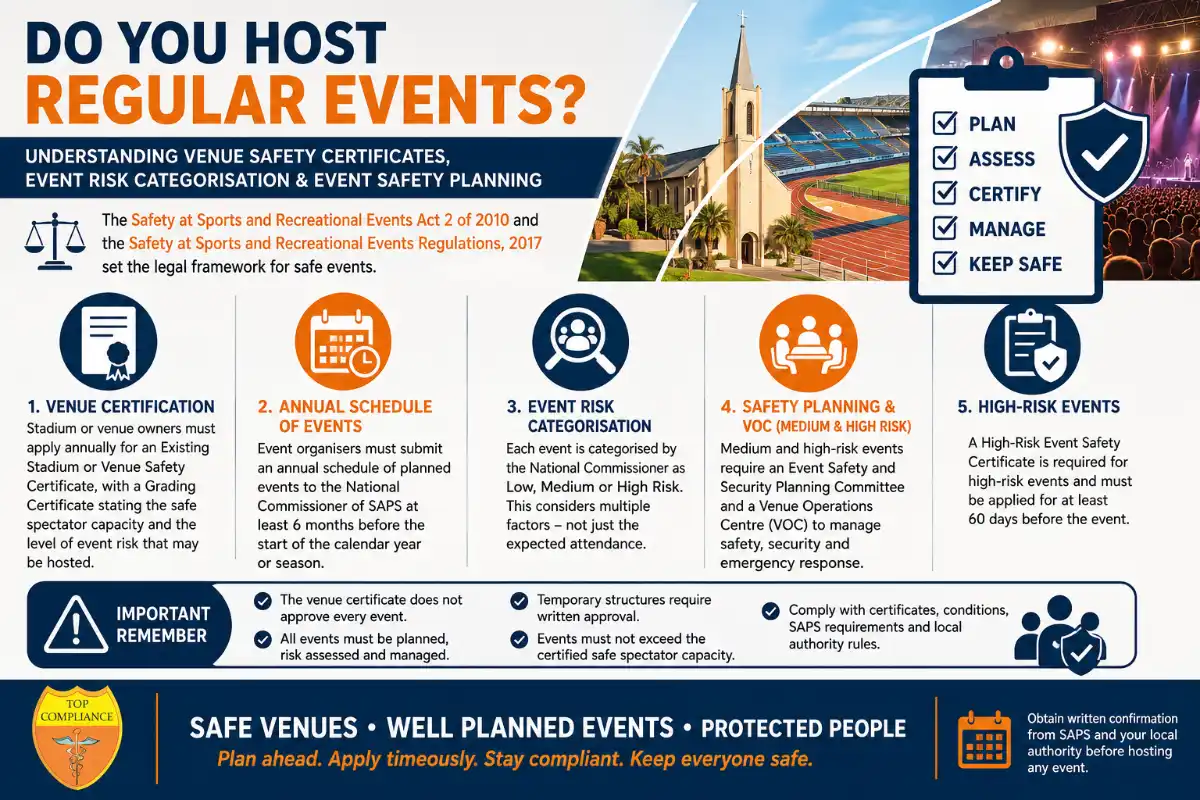
In the Safety at Sports and Recreational Events Act 2 of 2010, an “event” means:
Sporting, entertainment, recreational, religious, cultural, exhibitional, organisational or similar activities hosted at a stadium, venue or along a route or within their respective precincts.
The applicable legislation is:
Schools, churches and other venues may host sports fixtures, swimming galas, athletics meetings, concerts, festivals, conferences, religious gatherings and community activities throughout the year.
A common question is whether one annual certificate automatically approves all events held at the venue.
The legislation distinguishes between:
Does the Act apply to every activity?
The Act applies to events held at a stadium, venue or along a route where the event falls within the statutory definition of an “event”.
However, whether a particular ordinary school, church or community activity must follow the complete SASREA process will depend on the nature of the activity, where it is held, the persons attending and whether it is treated as an event under the Act.
The organiser should obtain written guidance from SAPS and the relevant local authority where there is uncertainty about whether the legislation applies to a particular activity.
Existing stadium or venue safety certificate, accompanied by a grading certificate.
A stadium or venue owner must apply annually to the relevant local authority for an existing stadium or venue safety certificate.
The application must be submitted at least 30 days before the existing certificate expires.
The existing stadium or venue safety certificate relates principally to the infrastructural safety of the stadium or venue.
It must be accompanied by a grading certificate issued by the local authority.
The grading certificate must state:
Where the owner wishes to host high-risk events, an application must also be made for a high-risk event grading certificate. The local authority may issue such a grading certificate only after consultation with the relevant authorised SAPS member.
Supporting documents for venue certification
The Regulations prescribe documents and information that may be required before an existing stadium or venue safety and grading certificate may be issued.
Depending on the stadium or venue, these may include:
The exact documents required must be confirmed with the relevant local authority.
Does the venue certificate approve every event?
No. An existing stadium or venue safety and grading certificate confirms the infrastructural safety, safe spectator capacity and approved risk grading of the venue.
It does not replace:
The event organiser and venue owner must also comply with the conditions stated in the applicable certificates.
Annual schedule of events
An event organiser must submit an annual schedule of planned events to the National Commissioner of SAPS.
The schedule must generally be submitted at least six months before the start of:
This may include recurring activities such as:
Including an event in an annual schedule does not automatically approve the event. It enables the event to be considered for risk categorisation.
Where an event was not reasonably foreseeable when the annual schedule was submitted, the organiser must submit the required information to the National Commissioner as soon as the organiser starts planning the event.
Event risk categorisation
The National Commissioner must categorise each event as:
These are risk categories and not merely attendance categories.
The number of persons expected to attend is one of several factors that may be considered.
Other relevant factors may include:
An event should therefore not be described as low, medium or high risk solely because a particular attendance threshold has been reached.
Requirements for a low-risk event
For a low-risk event, the event organiser must ensure that:
Being categorised as low risk does not remove the organiser’s duty to plan and manage the event safely.
Requirements for medium- and high-risk events
For medium- and high-risk events, the National Commissioner must establish an:
Event safety and security planning committee.
The committee may include relevant safety and security role-players, such as:
The committee considers the event’s safety and security arrangements and may issue conditions or directives that must be implemented.
Venue Operations Centre
A Venue Operations Centre, commonly referred to as a VOC, must be established for medium- and high-risk events.
The VOC is the operational command, control, communication and coordination centre for the event.
A VOC commander must be appointed in accordance with the Act.
The VOC must be properly equipped and must allow the relevant safety and security role-players to coordinate the management of the event.
What is a JOC?
“Joint Operations Committee” or “JOC” is a term commonly used by municipalities and operational authorities for coordinated event planning and approval processes.
However, the Safety at Sports and Recreational Events Act and its Regulations do not use “JOC application” as the formal name of the national statutory process.
The statutory structures created by SASREA include:
A municipality may nevertheless operate its own event-approval or JOC process under municipal by-laws, policies or administrative procedures.
The organiser must therefore comply with both:
High-risk event safety certificate
Where an event has been categorised as high risk, the event organiser must apply to the National Commissioner for a:
High-risk event safety certificate.
The application must be submitted at least 60 days before the event.
The National Commissioner may issue the certificate subject to conditions intended to protect persons and property at the event.
The high-risk event safety certificate is separate from the venue’s existing stadium or venue safety and grading certificate.
The event may not proceed contrary to the conditions of the applicable certificate.
Temporary structures and changes to the venue
A venue safety certificate does not automatically authorise temporary alterations or structures.
Where the holder of a venue safety certificate intends to alter or extend the stadium or venue by erecting a temporary structure, an application for written approval must be made to the local authority before the alteration or erection begins.
Temporary structures may include:
Temporary structures must not be used merely because the venue has an annual safety certificate.
Safe spectator capacity
Every event must be planned within the determined safe spectator capacity stated in the venue’s grading certificate.
The expected number of spectators must not exceed the certified safe spectator capacity.
Event organisers should also consider the number of:
The safe spectator capacity stated in the grading certificate must not be exceeded unless the capacity has been lawfully reassessed and the relevant certificate has been amended or replaced by the competent authority.
Public-liability insurance
The event organiser must have public-liability insurance for the event as required by the Act and Regulations.
The insurance must provide appropriate cover for the event and must comply with any prescribed requirements or conditions imposed by the relevant authorities.
Evidence of the applicable insurance should be retained with the event records.
Important questions to confirm
Schools, churches, venue owners and event organisers should obtain written confirmation from SAPS and the relevant local authority regarding:
Practical recommendations
Each applicable stadium or venue should maintain:
Conclusion
An annual existing stadium or venue safety and grading certificate relates to the safety, capacity and approved risk grading of the venue.
It does not constitute blanket approval for every event held at that venue.
Events must be included in an annual schedule or submitted when they become foreseeable, and each event must be risk categorised by the National Commissioner as low, medium or high risk.
The requirements applicable to the event will depend on its risk categorisation.
A high-risk event requires a separate high-risk event safety certificate, applied for at least 60 days before the event.
Medium- and high-risk events require an event safety and security planning committee and a Venue Operations Centre.
Schools, churches, venue owners and event organisers should obtain written confirmation from SAPS and the relevant local authority before relying on an annual venue certificate as authority to host a particular event.
The event organiser, stadium or venue owner and other event role-players remain responsible for ensuring that every event is properly planned, risk assessed and managed in accordance with the Act, the Regulations and the conditions imposed by the relevant authorities.
Disclaimer
This newsletter is intended for general information and awareness only.
It does not constitute legal advice, municipal approval, SAPS risk categorisation, event authorisation or a substitute for an event-specific risk assessment and safety plan.
The requirements applicable to an event depend on the nature, location, anticipated attendance, risk profile and categorisation of the event, as well as the conditions imposed by SAPS, the local authority and other relevant safety and security role-players.
Municipal event-approval processes, forms, fees and submission periods may be governed by separate municipal by-laws, policies and administrative procedures and may differ between municipalities.
Schools, churches, stadium or venue owners and event organisers must confirm the current requirements directly with the National Commissioner or relevant authorised SAPS member, the relevant local authority and any other competent authority before hosting an event.
Where necessary, written confirmation and professional legal or technical advice should be obtained.
Top Compliance (Pty) Ltd accepts no liability for any loss, delay, penalty, injury, damage or other consequence arising from reliance on this newsletter without first confirming the requirements applicable to the specific stadium, venue and event.
For more information, please contact us on info@topcompliance.co.za
Yours in Health and Safety
[ Download PDF ]