
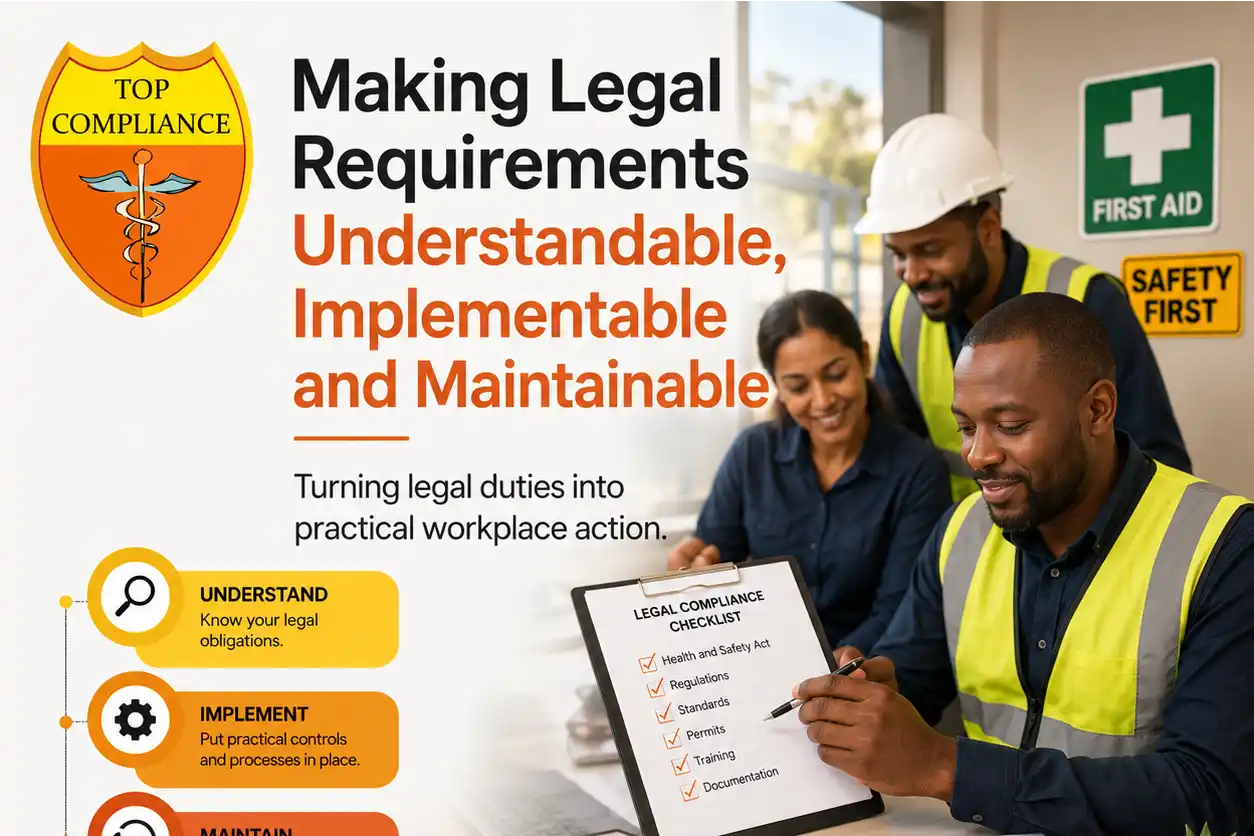
Turning legal duties into practical workplace action.
Most employers want to provide a safe and legally compliant workplace. However, occupational health and safety requirements can feel overwhelming when organisations must consider the Occupational Health and Safety Act, its regulations, incorporated standards, municipal by-laws, COIDA requirements and sector-specific obligations.
This can lead to a large safety file containing documents that are not fully understood, implemented or maintained. The documents may exist, but employees may still be unsure about:
An Occupational Health and Safety consultant can help bridge this gap by translating legal requirements into clear, practical actions that management, supervisors, employees, health and safety representatives and contractors can understand and apply.
Legal compliance should not remain in a file. It should become part of everyday workplace management.
Turning legal duties into workplace action
Section 8 of the Occupational Health and Safety Act 85 of 1993 requires an employer to provide and maintain, as far as reasonably practicable, a working environment that is safe and without risk to employees’ health. This includes identifying hazards, establishing safe systems of work, implementing precautionary measures and providing appropriate information, instruction, training and supervision.
Section 13 requires employers to inform employees about workplace hazards and the precautions they must take. Section 14 places duties on employees to take reasonable care, cooperate with the employer, comply with lawful health and safety requirements and report unsafe or unhealthy situations.
Compliance must therefore be understood by the people performing the work. A hazard identification and risk assessment, or HIRA, should influence how tasks are completed. Procedures must be communicated and followed, checklists must identify defects, and findings must lead to corrective action.
Closing the gap between paperwork and practice
Workplaces do not always fall short because they disregard safety. Problems often arise because legal requirements have not been converted into practical systems.
Examples include:
Each of these issues can be corrected through better communication, responsibility, monitoring and follow-up.
The practical role of an OHS consultant
An OHS consultant assists the employer in developing a system that is understandable, implementable and maintainable. This may include:
The consultant does not replace the employer’s legal responsibilities. The consultant provides structure, interpretation, practical guidance and support to help the employer fulfil those responsibilities.
Audits should promote improvement
An effective OHS audit looks beyond whether a document exists. It also considers whether the document is:
An audit should be viewed positively. It provides an opportunity to recognise what is working, identify areas requiring attention and correct weaknesses before they contribute to an incident or enforcement action.
Findings should be recorded in a corrective action plan, with responsible persons, realistic target dates and evidence of completion.
Training builds understanding
A policy cannot improve behaviour unless employees understand how it applies to their work.
Training should be based on workplace risks and may include:
Training should be reviewed when new employees are appointed, equipment or processes change, new hazards are introduced, or incidents, near misses and audit findings indicate that refresher training is needed.
Checklists must lead to action
A checklist is a practical control tool, not simply an administrative requirement.
Effective checklists help identify defects before they result in injury, damage or disruption. They should be completed honestly, reviewed by a responsible person and supported by timely corrective action.
Where the same defect appears repeatedly without being corrected, the checklist is not achieving its purpose.
The value is not in the tick. The value is in the action that follows.
Building a maintainable OHS system
Creating documents is only the beginning. Appointments expire, employees leave, chemicals and equipment are introduced, processes change, emergency routes become obstructed and procedures become outdated.
A maintainable system requires regular review and active participation. Management should monitor performance, health and safety representatives should inspect and report, committees should follow up on recommendations, and corrective actions should be tracked to completion. Management should therefore:
Practical clarity creates sustainable compliance
The value of an OHS consultant lies not only in understanding legislation, but in helping the employer answer practical questions:
What must be done? Who is responsible? How often must it be checked? What evidence must be retained? How will shortcomings be corrected?
Legal requirements become useful when they are understood, effective when they are implemented and sustainable when they are maintained.
A safety file demonstrates that documents exist. A functioning OHS management system demonstrates that the workplace is actively identifying hazards, controlling risks and protecting people.
[ Download ]