
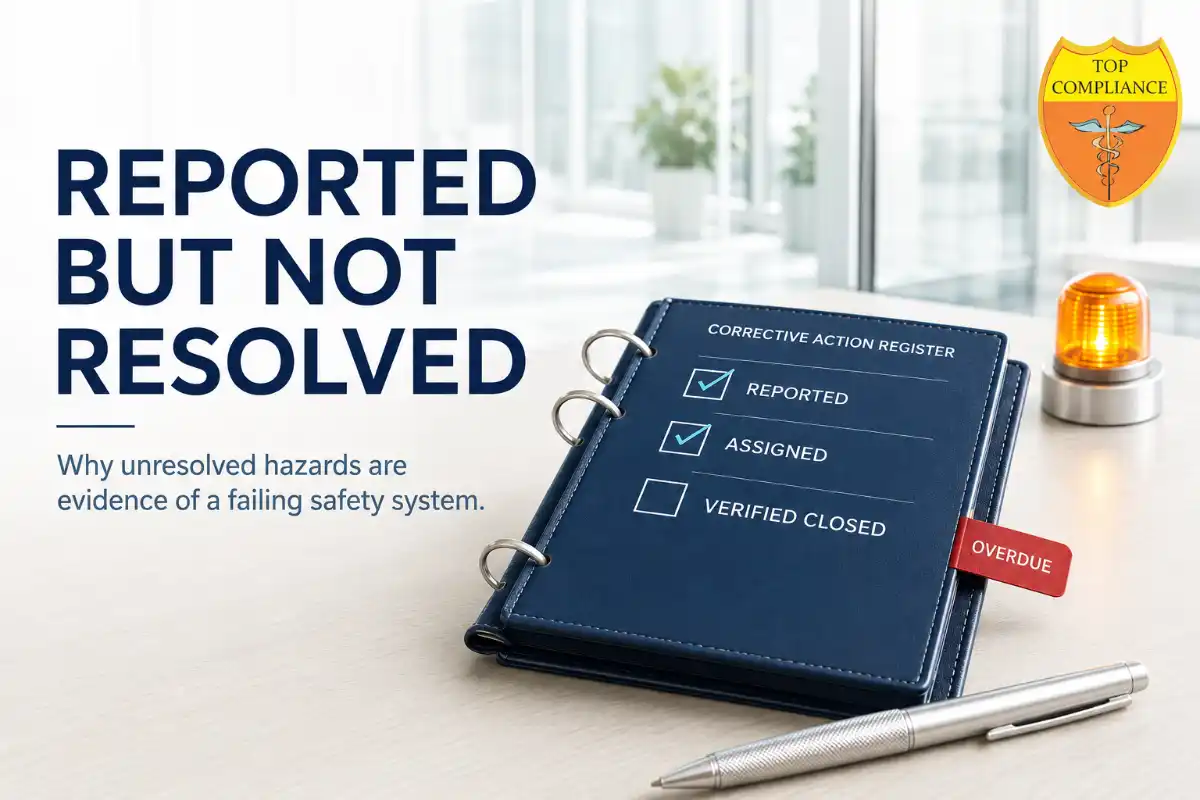
A hazard report is not the end of the safety process. It is the point at which the employer becomes aware of a condition that may require control. If the matter is recorded but no suitable action follows, the workplace has evidence of awareness without evidence of effective risk control.
Reporting is only the first step
Workplace inspections, employee reports, maintenance requests, incident investigations and health and safety committee meetings regularly identify hazards. These reporting channels are important because they bring unsafe or unhealthy conditions to the attention of people who can act. However, a report does not remove a hazard. A completed checklist, signed inspection form or entry in a maintenance book is evidence that an issue was identified; it is not proof that the risk was controlled.
A functioning safety system must connect hazard identification to decision-making, control, follow-up and verification. Where the same issue appears repeatedly, remains overdue without interim protection, or is marked as resolved without confirming that the risk was actually reduced, the system is no longer operating as an effective preventive control.
What the Occupational Health and Safety Act requires
Section 8(1) of the Occupational Health and Safety Act 85 of 1993 requires every employer, as far as is reasonably practicable, to provide and maintain a working environment that is safe and without risk to the health of employees. This is an active and continuing duty. It is not satisfied merely because hazards have been listed or reported.
Section 8(2) explains important parts of that duty. In particular, the employer must provide and maintain safe systems of work, plant and machinery; take reasonably practicable steps to eliminate or mitigate hazards before relying on personal protective equipment; identify hazards and determine the precautionary measures required; provide the means to apply those precautions; provide necessary information, instruction, training and supervision; avoid permitting work until required precautions have been taken; ensure compliance; enforce necessary safety measures; and provide suitable general supervision.
Where learners, visitors, customers, contractors or members of the public may be directly affected, section 9(1) requires the employer to conduct the undertaking so that, as far as is reasonably practicable, these persons are not exposed to health or safety hazards arising from the employer’s activities.
Section 13(a) requires employees to be made conversant, as far as is reasonably practicable, with the hazards connected to their work and with the precautions that must be taken. Section 14(d), in turn, requires an employee who becomes aware of an unsafe or unhealthy situation to report it as soon as practicable to the employer or the relevant health and safety representative, who must report it to the employer.
| Important distinction: The Act does not prescribe one general corrective-action register or a fixed deadline for every workplace hazard. The required response depends on the nature and level of risk and what is reasonably practicable. A register is a useful management tool, but it must support real control rather than replace it. |
An open action is not automatically a failure
Some corrective actions cannot be completed immediately. A specialist may need to inspect equipment, replacement parts may need to be sourced, or a permanent engineering solution may require planning. A matter can therefore remain open without the safety system failing, provided the risk is being actively managed.
An effective open action should show:
The failure occurs when management knows about the hazard but cannot show that the risk was assessed, temporarily controlled where necessary, assigned, monitored, escalated and eventually verified as resolved. High-risk conditions may require work or use of equipment to stop until suitable precautions are in place. Lower-risk matters may be scheduled, but they must not disappear into an indefinite list.
From report to verified close-out
Basic workplace examples
Damaged step ladder: A pre-use inspection identifies a cracked step. Recording the defect is not enough. The ladder should be prevented from being used while an authorised person arranges its appropriate repair or replacement. The action may be closed only after the unsafe ladder is no longer available for use and the replacement or repair has been checked.
Blocked emergency exit: A monthly inspection records boxes in front of an exit. Removing the boxes is the necessary immediate action, but repeated obstruction shows that the cause has not been controlled. The permanent response may require designated storage, clear demarcation, supervision and follow-up inspections.
Recurring water leak: Staff repeatedly report a wet floor. Drying the area and restricting access may reduce the immediate slip risk, but the matter should remain open until the leak is repaired and the area is checked. Repeatedly placing a warning sign without addressing the source is not an effective close-out.
The role of health and safety representatives
Section 18(1) provides that health and safety representatives may review the effectiveness of health and safety measures, identify potential hazards, investigate employee health and safety complaints, make representations to the employer or health and safety committee, and inspect the workplace at agreed intervals. If representations on specified matters are unsuccessful, section 18(1)(e) allows the representative to make representations to an inspector.
A representative should therefore do more than record the same deviation each month. Previous findings should be followed up, recurring hazards highlighted and unresolved significant matters formally raised. This does not transfer the employer’s duty to the representative. Under section 8 the employer retains the general duty, and section 16 requires the chief executive officer, as far as is reasonably practicable, to ensure that the employer’s duties are properly discharged. Assigning duties does not, by itself, relieve the chief executive officer or employer of responsibility or liability.
The role of the health and safety committee
Under section 19(1), the employer must consult the health and safety committee with a view to initiating, developing, promoting, maintaining and reviewing measures that ensure employee health and safety. Section 20(1)(a) allows the committee to make recommendations to the employer and, where those recommendations fail to resolve the matter, to an inspector. Section 20(2) requires the committee to keep a record of each recommendation made to the employer and of reports made to an inspector under section 20(1)(b).
Committee minutes should therefore record the actual issue, the recommendation, the employer’s response, the person responsible, the due date and the outcome of follow-up. Repeating ‘matter discussed’ for several meetings without a decision, escalation or control is not meaningful consultation or review.
When unresolved hazards can lead to enforcement
Section 30 gives inspectors significant enforcement powers. Where an act or the use of plant or machinery threatens or is likely to threaten a person’s health or safety, an inspector may issue a written prohibition. Where an employer or user fails or refuses to take reasonable safety steps, an inspector may issue a written direction requiring specified steps within a specified period. An inspector may also direct steps necessary to comply with an applicable regulation.
Failure to comply with duties listed in section 38(1), including relevant duties under sections 8, 9, 13 and 14, may constitute an offence. An organisation should therefore not wait for an injury, complaint or inspector’s notice before addressing known risks. Records showing repeated reports without suitable action may demonstrate that management knew about the condition but failed to implement or enforce the necessary controls.
Signs that the close-out system is failing
A practical management standard
Management should be able to answer the following questions for every significant open hazard:
The key message
A report creates awareness. A control reduces risk. A verified close-out demonstrates that the safety system worked. A workplace that records hazards but repeatedly fails to act, monitor and verify is maintaining evidence of problems rather than evidence of prevention.
Effective health and safety is not measured by the number of forms completed. It is measured by whether hazards are identified early, controlled appropriately, assigned to accountable persons, followed through and prevented from recurring.
Legal references and verification
Occupational Health and Safety Act 85 of 1993, particularly sections 1 (‘reasonably practicable’), 8, 9, 13, 14, 16, 18, 19, 20, 30 and 38; read with the Occupational Health and Safety Amendment Act 181 of 1993. Legal wording and amendment status were checked against official South African Government sources in August 2026.
For more information, please contact us on info@topcompliance.co.za
Yours in Health and Safety
[ Download PDF ]