
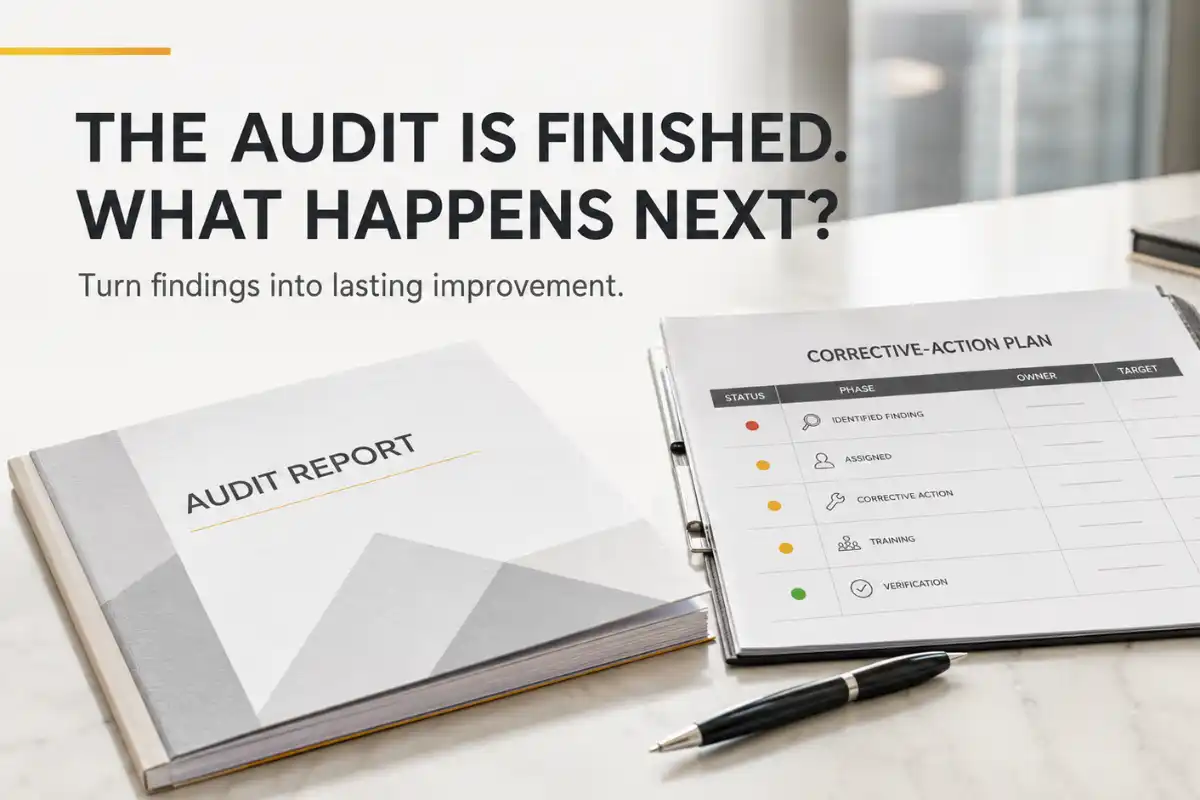
Turning audit findings into practical, risk-based and sustainable improvement
An audit does not complete the health and safety process. It provides a dated picture of the workplace, the available evidence and the controls observed. The real value begins when findings are understood, prioritized, assigned, corrected and verified.
An occupational health and safety audit helps an employer identify strengths, gaps and areas that require attention. It may examine legal appointments, risk assessments, procedures, training, inspections, emergency arrangements, contractor controls, incident records and physical workplace conditions. The report records what was available and observed within the agreed scope on the audit date.
The report is not proof that the workplace will remain safe after the auditor leaves. Equipment deteriorates, people change roles, new chemicals and machinery are introduced, procedures become outdated and previously corrected hazards may return. Compliance therefore requires ongoing management, not a once-off response prepared for the next audit.
Section 8(1) of the Occupational Health and Safety Act 85 of 1993 requires every employer, as far as is reasonably practicable, to provide and maintain a working environment that is safe and without risk to the health of employees. The duty is active and continuing.
Section 8(2) supports that duty by requiring, among other matters, safe systems of work, the identification of hazards, steps to eliminate or mitigate hazards, the means to apply precautionary measures, necessary information, instruction, training and supervision, enforcement of safety measures and supervision by a person trained to understand the hazards and authorised to ensure that precautions are taken.
Where learners, visitors, customers, contractors or members of the public may be directly affected by the employer’s activities, section 9(1) requires the undertaking to be conducted so that, as far as is reasonably practicable, those persons are not exposed to health or safety hazards.
Section 13 requires employees to be informed of the hazards connected to their work and the precautions that must be taken. Section 14 requires employees to take reasonable care, cooperate with the employer, obey lawful health and safety requirements and report unsafe or unhealthy situations.
Section 16 requires the chief executive officer, as far as is reasonably practicable, to ensure that the employer’s duties are properly discharged. Duties may be assigned to people under the chief executive officer’s control, but the assignment does not by itself remove the responsibility of the chief executive officer or the employer.
Important distinction: The Act does not create one universal OHS audit score, pass mark, audit frequency or fixed correction period for every finding. Specific regulations, standards, manufacturer instructions or local requirements may prescribe particular inspections, examinations or review periods. Otherwise, the response must be based on the applicable legal duty, the level of risk and what is reasonably practicable.
Review and understand every finding
Management should read the report carefully and confirm what the finding means, which area or activity is affected, who may be exposed and what evidence was missing or inadequate. If clarification is needed, it should be obtained before the action is assigned. Clarification must not become a reason to leave an evident hazard uncontrolled.
Prioritise according to risk and legal urgency
Findings should not simply be addressed in page order or according to which items are easiest to complete. A serious physical hazard may require immediate action, while a lower-risk administrative improvement may be planned over a reasonable period. Missing documents are not automatically low risk, because the absent document may represent a missing control, such as a risk assessment, emergency procedure, inspection record or evidence of required competence.
Immediate attention: conditions that present imminent or serious risk, prohibited work, unsafe equipment or ineffective critical controls.
High priority: significant legal or operational weaknesses requiring prompt action and management oversight.
Planned improvement: lower-risk matters that can be scheduled while suitable controls remain in place.
Evidence and administration: records, appointments and documents needed to support, communicate and prove implementation.
Apply immediate or interim controls
A permanent solution may require a competent contractor, specialist advice, procurement or planned maintenance. Where the risk cannot be permanently corrected at once, an effective interim control should be applied and monitored. Depending on the risk, this may include stopping the activity, isolating equipment, restricting access, changing the work method or providing closer supervision. A warning sign alone is not sufficient where a stronger reasonably practicable control is available.
Create a corrective-action plan
The audit report should be converted into a working corrective-action plan. The plan should be simple enough to maintain but detailed enough to show active control. For each finding, it should record:
Assign authority, resources and accountability
A finding assigned only to ‘maintenance’, ‘HR’ or ‘the safety representative’ is easily lost. A named person should own the action and should have access to the time, authority, information and resources needed to complete it. Senior management should resolve barriers involving budget, procurement, operational pressure or competing priorities.
Health and safety representatives may inspect, report and make recommendations, but they do not inherit the employer’s general legal duty. Management must not transfer responsibility for all audit findings to representatives who do not have the authority or resources to correct them.
Communicate the relevant changes
Employees should be informed where findings affect their work, access routes, equipment, emergency actions or required precautions. Updated risk assessments, safe working procedures, checklists and emergency arrangements should be communicated to the people who must apply them. A revised document in a file is not an effective control if the relevant employees continue working according to the old method.
Verify before closing
An action is not complete merely because an email was sent, a quotation was accepted, training was booked or a contractor visited the site. Closure should confirm that the required action was completed, the control is functioning, affected persons understand the change and the risk has been removed or reduced as intended. Repeated findings should trigger a review of the underlying cause.
Audit findings frequently reveal a knowledge or competence gap. A health and safety representative may have been appointed but may not know how to conduct a meaningful inspection. A manager may understand that a finding must be closed but may not know how to prioritize risk, select controls, provide resources or verify effectiveness. Training should therefore form part of the corrective-action plan where knowledge, skill or supervision contributed to the finding.
Section 18 describes the functions of health and safety representatives. These include reviewing the effectiveness of health and safety measures, identifying potential hazards, investigating employee complaints, making representations and inspecting the workplace at intervals agreed with the employer. Section 18(3) requires the employer to provide the facilities, assistance and training that a representative may reasonably require and that have been agreed upon for the performance of those functions.
Representative training should be relevant to the workplace and may include:
Managers and supervisors need enough OHS knowledge to carry out the responsibilities attached to their level of control. This supports the employer’s duties under section 8, the chief executive officer’s oversight under section 16 and the requirement for suitable information, training and supervision. Training should help management understand:
Training frequency: The OHS Act does not prescribe one general annual refresher course for every manager or health and safety representative. Training must be sufficient for the person’s functions and workplace risks. Refresher or additional training should be provided when appointments or duties change, new hazards are introduced, procedures are revised, audit findings reveal gaps, inspections are poorly completed, incidents or near misses occur, or knowledge and competence have deteriorated.
Training may include formal courses, site-specific briefings, coached inspections, toolbox talks, emergency drills, committee guidance and practical assessment. An attendance register or certificate shows participation. It does not, on its own, prove that the person understands the role or can apply the required controls.
Section 19 requires an employer to establish one or more health and safety committees at a workplace where two or more health and safety representatives have been designated. The employer must consult the committee with a view to initiating, developing, promoting, maintaining and reviewing measures that ensure employee health and safety. A committee must meet as often as necessary, but at least once every three months.
Under section 20, a committee may make recommendations to the employer and, where recommendations fail to resolve the matter, to an inspector. The committee must keep a record of recommendations made to the employer and reports made to an inspector under that section.
After an audit, a meaningful committee review should consider:
Committee minutes should record recommendations, decisions, responsibilities and follow-up. Repeating ‘matter discussed’ without a decision or outcome does not provide a useful management or consultation record.
Blocked emergency exit. The obstruction should be removed immediately. The longer-term action may include designated storage, floor demarcation, employee communication, supervision and follow-up inspections to prevent the obstruction from returning.
Poorly completed representative checklist. The response should not be limited to telling the representative to complete the form properly. Management should confirm whether the checklist reflects the site’s risks, provide practical training, observe an inspection, correct misunderstandings and review later records for improvement.
Machine used without an essential guard. The equipment should be prevented from being used until a suitable guard and required precautions are in place. The employer should also examine why the defect was not identified earlier and whether pre-use checks, maintenance, training or supervision must be improved.
Common failures after an audit
Enforcement: Where an act or the use of plant or machinery threatens or is likely to threaten health or safety, section 30 allows an inspector to issue a prohibition. An inspector may also direct specified safety steps where an employer or user has failed or refused to take reasonable safety measures. Failure to comply with duties listed in section 38 may constitute an offence.
This is a management example, not a statutory deadline. The timing of each action must still be determined by the risk, the applicable legal requirement and what is reasonably practicable.
First 48 hours: review serious findings, stop or restrict unsafe activities where necessary and apply immediate controls.
First week: brief responsible managers, build the action plan, assign owners and confirm resource requirements.
First two weeks: communicate relevant changes and start the training or coaching identified by the audit.
First month: review progress with management and the committee, verify completed actions and escalate delays.
Ongoing: monitor controls, review evidence, update HIRAs and procedures where required and confirm that findings do not recur.
A better audit result is useful, but it should not be the only measure of progress. Management should also consider whether high-risk conditions have been controlled, repeated findings are decreasing, inspections are more meaningful, actions are closed on time, representatives and managers are more competent, employees understand the required precautions and committee recommendations produce visible results.
The key message: An audit identifies the gap. Management decides the priority. Responsible persons implement the control. Training builds the ability to maintain it. Verification confirms whether the risk was reduced. The next audit should confirm sustained improvement, not restart the same unfinished process.
[ Please download ]